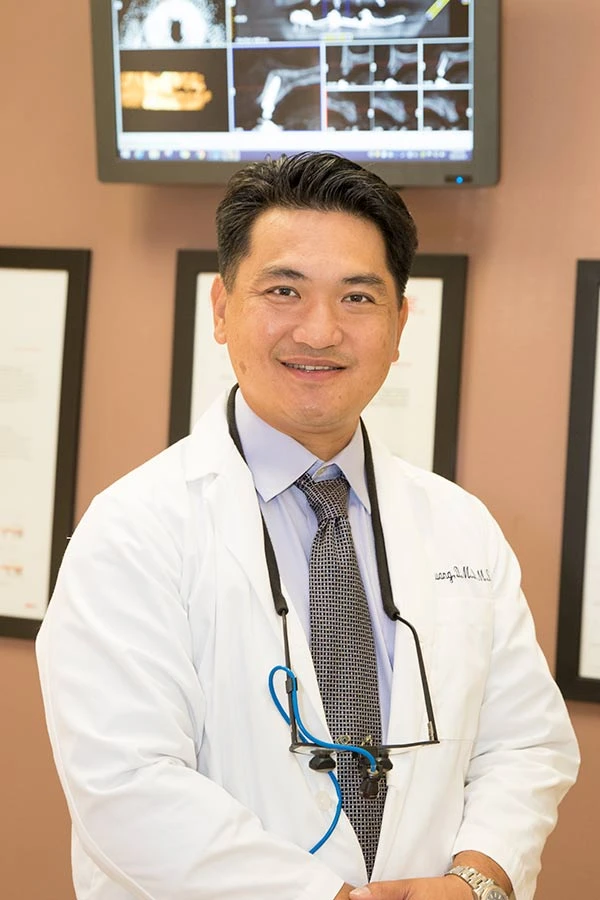
Platelet-rich fibrin (PRF) and concentrated growth factors (CGF) are biologic adjuncts derived from your own blood that we routinely incorporate into implant and grafting surgery. They accelerate healing, improve bone graft integration, and reduce post-operative complications. Dr. Allen Huang has published clinical research on PRF applications in sinus lift bone regeneration and uses these biologic protocols in nearly every grafting and complex implant case at our practice.
Both PRF (platelet-rich fibrin) and CGF (concentrated growth factors) are biologic preparations made from a small sample of your own blood, drawn at the start of your appointment. The blood is processed in a centrifuge using specific protocols that separate the platelet- and growth-factor-rich layer from the other blood components.
The result is a fibrin matrix — a soft, gel-like material containing high concentrations of platelets, growth factors, and stem cells from your own circulation. Because the material is autologous (made entirely from your own blood), there’s no risk of rejection, no donor-site concerns, and no foreign material introduced.
PRF and CGF are similar in concept but differ in centrifuge protocol. CGF generally produces a denser, more sustained-release fibrin matrix, while PRF is faster and more flexible to produce. We select between them based on the specific clinical use.

Biologic adjuncts are not used the same way in every case. The most common applications in our practice:
Dr. Huang’s interest in biologic adjuncts isn’t just clinical — he has published research in the field. His work on platelet-rich plasma applications in sinus lift bone regeneration was conducted during his periodontics and implantology residency at the University of Illinois at Chicago, where he served as the program’s first Chief Resident.
This research background matters because PRF and CGF protocols vary widely in clinical practice. Centrifuge speeds, processing times, and application techniques all affect the biologic activity of the final product — and small variations in protocol can produce meaningfully different outcomes. Our protocols are calibrated based on the underlying biology, not just on equipment manufacturer recommendations.
The blood draw at the start of your appointment is the same volume as a routine medical lab draw — typically 20–40ml depending on the case. The centrifuge processing happens during the early part of your surgical preparation, so by the time the surgery begins, the PRF/CGF is ready for use.
Patients receiving PRF or CGF typically report less post-operative pain, less swelling, and faster soft-tissue healing compared to procedures performed without biologic adjuncts. The differences aren’t always dramatic in routine cases, but they tend to be most noticeable in larger surgical procedures — full-arch placement, sinus lifts, and complex grafting.
Most of our complex grafting and full-arch protocols include PRF or CGF as a standard part of the procedure rather than an upcharge — because we’ve found that the improved predictability is worth the small additional cost on our side. For routine single-implant cases without grafting, we generally don’t use PRF unless there’s a specific clinical reason. We discuss any case-specific recommendations transparently during your consultation.
Biologic adjuncts are powerful clinical tools, but they aren’t magic. They don’t make a poorly planned implant case successful. They don’t substitute for adequate bone, proper surgical technique, or appropriate case selection. We use them as adjuncts to high-quality implant and grafting surgery — not as a replacement for it.
We mention this because PRF is sometimes marketed in dental practices as a stand-alone “wellness” therapy or a way to dramatically improve outcomes that would otherwise be marginal. The honest clinical reality is more modest: PRF and CGF predictably improve healing in well-planned cases, particularly when the surgical insult is significant.