When one tooth is missing, the standard of care matters. A single implant placed with CBCT planning, digital design, and board-certified surgical precision is a permanent solution — not a temporary fix.
I see this every week — a patient who lost one tooth years ago and assumed it wasn't urgent. By the time they come to see me, the adjacent teeth have tipped, the bone has resorbed, and what was once a straightforward implant case has become a complex one requiring grafting. The tooth you're missing today is setting the conditions for everything around it.
At Significance Dental Specialists, a single tooth implant begins with a CBCT 3D cone-beam scan — not a standard 2D X-ray. That scan tells me the exact bone volume, density, and anatomy at the implant site before I make a single incision. From there, I use Simplant or Nobelvision digital planning software to position the implant virtually, optimize the angle, and design a surgical guide. The final crown is designed using iTero digital impressions — no goopy trays, no guesswork.
Schedule Consultation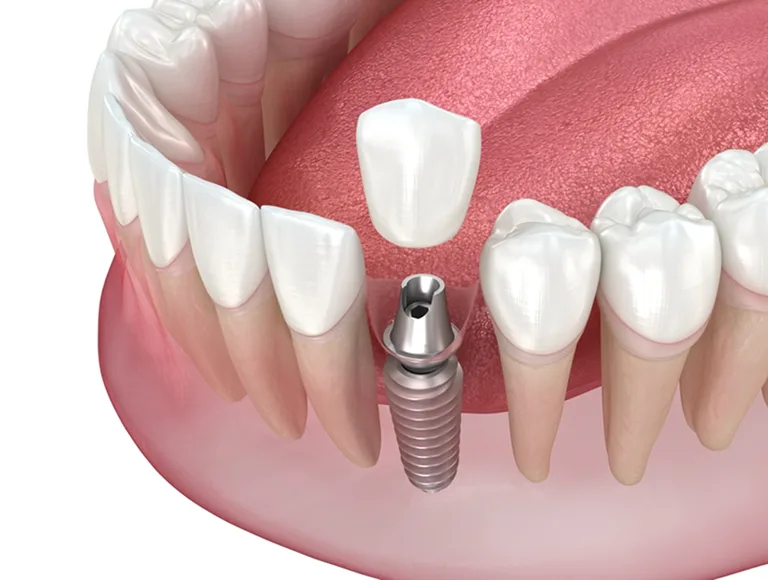
A traditional bridge requires grinding down the two healthy teeth on either side of the gap — permanently damaging sound tooth structure to hold a three-unit prosthetic. A partial denture moves when you eat and does nothing for bone preservation. A single implant replaces the root itself, not just the crown above the gumline.
The three components of a single implant:
Osseointegration — the biological fusion of titanium with living bone — is what gives implants their permanence. It is not adhesive. It is not mechanical retention. It is bone growing into the implant surface at the microscopic level.
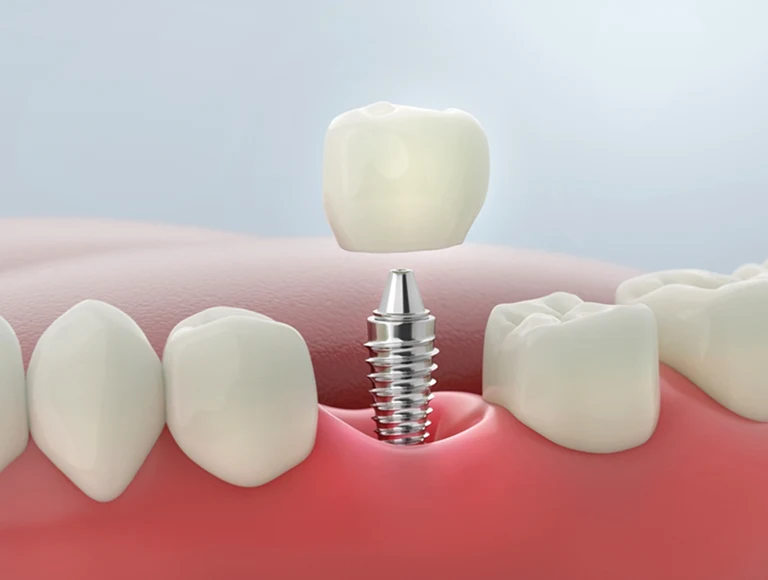
Alveolar bone — the bone that holds your teeth — exists because of the mechanical stimulation those teeth provide. When a tooth is lost, that stimulation stops. Within the first year, studies show up to 25% of bone volume at the extraction site can be lost. After three years, the bone loss can be substantial enough to require grafting before an implant can be placed.
Beyond bone, adjacent teeth begin to drift and tilt toward the gap. The opposing tooth may super-erupt — moving downward or upward into the empty space. These shifts affect bite, chewing efficiency, and create cleaning problems that accelerate periodontal disease in the surrounding area.
Replacing a single tooth promptly is not cosmetic urgency. It is structural medicine.
A single tooth implant seems straightforward. Place a post, attach a crown. But implant placement is a three-dimensional surgical procedure that depends entirely on bone quality, angulation, gum tissue management, and prosthetic planning. A poorly placed implant — too shallow, too angled, too close to adjacent roots — creates problems that are difficult and expensive to fix.
As a Board-Certified Periodontist and Diplomate of the American Board of Periodontology, I have placed more than 20,000 implants over 20+ years of practice across 8 countries. Board certification means my surgical outcomes have been independently evaluated against a national standard — a process fewer than 3% of dentists complete.
Every single implant case at Significance Dental Specialists is planned with CBCT imaging and Simplant/Nobelvision digital surgical guides. The crown is designed using iTero scanning and fabricated to precise specifications. Nothing about this is guesswork.
From first appointment to final crown, here is exactly what to expect:
A 3D cone-beam CT scan is taken at your first visit. I review the scan with you directly — showing you the bone volume, nerve positions, and proposed implant site. Simplant or Nobelvision software is used to plan the implant position virtually and design a surgical guide for precise placement.
Using the surgical guide from digital planning, the implant fixture is placed into the jawbone through a minimally invasive approach. Most single-tooth cases are completed under local anesthesia in under an hour. IV sedation is available if preferred. A healing abutment or temporary crown is placed the same day in most cases.
The implant integrates with the surrounding bone over the following weeks. You eat normally — with minor dietary caution around the implant site. I monitor healing with periodic check-ins. Once osseointegration is confirmed, we move to the final restoration.
An iTero digital impression captures the exact geometry of the implant and surrounding teeth. No traditional impressions needed. The final crown — zirconia or PFM — is fabricated to match your natural dentition precisely. One seating appointment and the case is complete.
Traditional crown impressions use vinyl polysiloxane (VPS) material pressed over the implant abutment — a process prone to distortion, displacement, and inaccuracy, particularly in the posterior arch. At Significance Dental Specialists, I use iTero digital scanning for all final implant restorations.
The iTero scanner captures a precise 3D model of the implant site, adjacent teeth, and opposing arch in minutes. That model is sent digitally to the lab for crown fabrication. The result: a crown that seats correctly on the first try, with accurate contact points, proper emergence profile, and a color match to your natural teeth that doesn't look placed — it looks grown.
Schedule Consultation
Single tooth implants placed with proper surgical protocol and prosthetic design have among the highest long-term success rates of any dental procedure — consistently above 95% at 10 years in peer-reviewed literature. With board-certified surgical placement and digital crown design, the outcomes at our practice reflect this standard.
I have patients who received implants from me 15 years ago whose restorations remain structurally sound and indistinguishable from their natural teeth. That is the standard I hold every case to.

Most adults with a missing or failing tooth are candidates for a single implant. The CBCT scan — taken at your first consultation at no additional charge — gives me the definitive answer. Key factors I evaluate:
If bone grafting is needed, I perform it. Ridge augmentation, socket preservation, sinus lift — these are periodontal surgical procedures I perform routinely as a Board-Certified Periodontist. Bone deficiency is not an automatic disqualifier.

Your consultation includes a CBCT 3D scan, a full clinical assessment, and a direct conversation with Dr. Huang about your options. You will leave with a clear treatment plan, a timeline, and honest answers — not a sales pitch.
Significance Dental Specialists has four Las Vegas locations. Most patients are seen within one week of calling.